1. How Much Does Frozen Freshwater Clam Meat Cost per Kg?
Frozen freshwater clam meat costs approximately $1.5–3.0 per kg FOB China in bulk, with the exact figure set by three variables: grade (pieces per kilo), processing form, and whether the quoted weight is net meat or glazed weight. The question how much does frozen freshwater clam meat cost per kg therefore has no single answer — but the spread is narrow and predictable, which is what makes it useful for cost modelling.
Grade. Small grades (1,000–1,500 pcs/kg) sit at the bottom, around $1.5–2.2/kg, because they are the highest-yield output of the line and suit sauces, fillings, and seasoning. Mid grades (1,500–2,000 pcs/kg) run $1.8–2.5/kg — the workhorse for dumplings, soups, and retort meals. Large grades (2,000+ pcs/kg) reach $2.0–2.8/kg and hold visual identity in canned and retail products.
Processing form. Boiled, shell-separated IQF meat is the cheapest per usable kilo because the labour-heavy steps are already done. Cooked whole-shell product and live product both cost more per kilo of meat once you account for shell weight and handling.
The glazing trap. A carton quoted at 10kg with a 15% ice glaze delivers 8.5kg of meat. At a nominal $2.20/kg that is an effective $2.59/kg — an 18% swing that never shows up on the quotation. Ask whether the price is net weight (drained) or gross including glaze, and get the glaze percentage in writing.
For reference, saltwater Manila and short-neck clam meat trades at roughly $2.5–5/kg FOB for comparable grades, so the freshwater spread is not marginal — it is a structural 30–50% advantage that comes from lake harvesting costs and year-round supply. That is why buyers comparing live product against processed meat usually find the processed side cheaper per serving: Live river clams carry shell weight, mortality in transit, and shucking labour that never appear in the per-kilo price.
✅ Bottom line: model your cost at $2.0–2.6/kg net of glaze for mid grades, and treat any quote below $1.5/kg as a glazing or grading question, not a bargain.
2. What Is the Clam Meat Cost per Serving for Processed Food Brands?
At $2.00/kg net, a 30g clam meat portion costs about $0.06 in ingredient — and because the meat is fully cooked and shell-free, that figure is the true cost with no yield loss added. Getting to a reliable clam meat cost per serving for processed food brands means multiplying three numbers: net price per kilo, grams per serving, and yield loss in your own process.
For Quick-frozen clam meat, in-process yield loss is close to zero — there is no shell, no viscera, no trim to discard, and thaw drip is typically under 5% when the product is tempered correctly. Compare that with whole-shell or live input, where 1kg of landed product yields only 200–300g of meat after shucking.
Here is how the ingredient cost stacks up against the proteins a product developer would actually substitute:
|
Ingredient (indicative wholesale price) |
Cost per 30g serving |
Notes for formulation |
|
Freshwater clam meat, IQF ($1.5–3.0/kg) |
$0.05–0.09 |
Cooked, shell-free, ~0% trim loss |
|
Squid, cleaned tubes ($3–5/kg) |
$0.09–0.15 |
Needs portioning, higher chew |
|
Mussel meat, cooked ($3.5–5/kg) |
$0.11–0.15 |
Stronger flavour carry-over |
|
Shrimp, peeled PD ($6–9/kg) |
$0.18–0.27 |
Visual premium, highest cost |
|
Manila clam meat ($2.5–5/kg) |
$0.08–0.15 |
Brinier, seasonal supply risk |
Read the table as a formulation tool, not a price list. Clam meat does two jobs at once: it supplies protein mass and it supplies glutamate-type savouriness, which in many recipes lets a developer reduce added yeast extract and MSG-adjacent seasonings. In a retort soup or a dumpling filling that secondary saving often exceeds the protein saving — worth testing in a kitchen trial.
Volume matters too. One 20ft container — 8–10 tons — is 260,000–330,000 servings of 30g, so a $1.00/kg difference in landed price is $8,000–10,000 per container. That is why the glazing question is worth ten minutes.
✅ Bottom line: budget $0.05–0.09 per 30g serving for clam meat, and validate the saving against the seasoning reduction it enables.
3. Choosing a Frozen Freshwater Clam Meat Supplier for Food Manufacturers
The right frozen freshwater clam meat supplier for food manufacturers is the one that documents grading tolerance, glaze percentage, purge protocol, and batch traceability before you sign — because those four items decide whether a cheap quote produces a repeatable product. Price is the easiest variable for an importer to compare and the least reliable predictor of total cost.
Screen suppliers on these points:
- Grading tolerance in writing. "1,000–1,500 pcs/kg" should come with an accepted deviation, not a best-effort statement. A batch that drifts small changes your portion count and your cost per serving.
- Glaze declaration. Percentage stated per carton, net weight confirmed on the packing list, and a sample you can drain and weigh yourself.
- Purge and sand-removal protocol. Multi-stage depuration — soaking, roller scrubbing, flow-water cleaning, vibration sorting, manual inspection — is the difference between a clean ingredient and a customer complaint.
- Certification and inspection records. Food safety inspection documentation per batch, plus the export health certificate for your market.
- Traceability to harvest area. For freshwater product this means lake source and harvest date, which also underpins the biotoxin-free claim you may want on pack.
- Commercial terms. One 20ft container minimum, 20–25 days production lead time, 24-month shelf life at -18°C, OEM and private-label artwork support, and a 1kg sample before commitment.
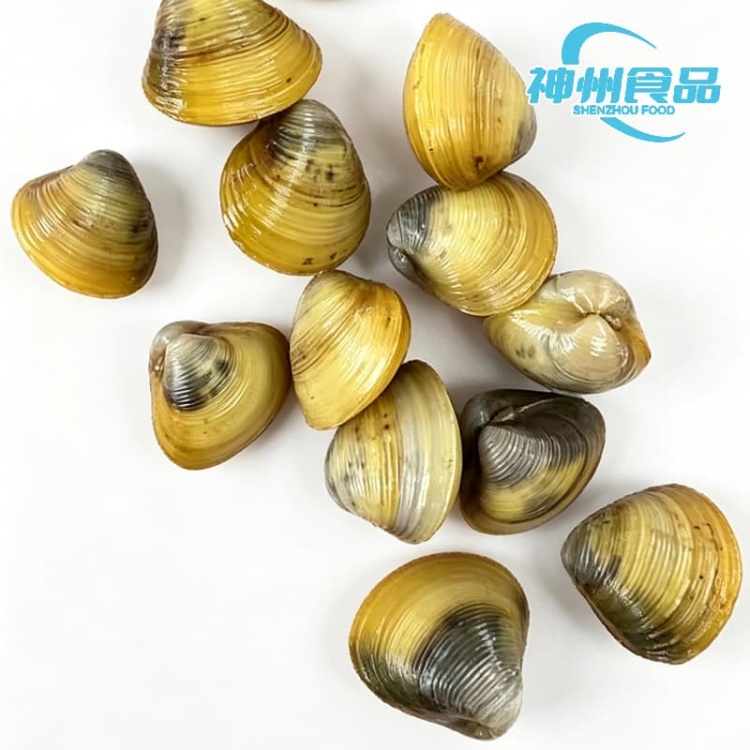
Huai'an Shenzhou Food Technology Co., Ltd. operates three dedicated lines with 3,000 tons of annual output, which matters practically: capacity already running the grade you need produces consistent batches, while a trading intermediary sources whatever is available that month. Industrial buyers typically begin with Frozen river clams in 10kg bulk cartons, run a trial batch, then convert to a private-label retail pack once the formulation is locked.
✅ Bottom line: a supplier who will not put grading tolerance and glaze percentage in writing is quoting a different product from the one you will receive.
FAQ
Q: What is the minimum order for a first trial? A: One 20ft container, approximately 8–10 tons, is the standard commercial minimum. Before that, Shenzhou ships a 1kg sample so your R&D team can run a full trial batch and confirm the grade and glaze specification.
Q: Can you supply organic or additive-free clam meat for EU or US retail? A: The product is boiled and frozen with no additives — the ingredient statement is simply clam meat. Certification requirements differ by market, so send your target market and retailer standard, and we will confirm which documentation the shipment can carry before quotation.
Q: How do you handle price stability across a year? A: Freshwater lake harvesting runs year-round, so programs are quoted on annual volume with a quarterly price review rather than spot pricing. That predictability is worth more to a food manufacturer than a single low quote.
Get the Cost-per-Serving Model
Shenzhou will send a buyer package within 24 hours: current FOB price list by grade, net-weight and glazing options, yield and cost-per-serving worksheet, and a 1kg sample for your test kitchen. If you are formulating a frozen meal, canned product, or dumpling line, send your serving size and target cost and we will return the maths. Contact Huai'an Shenzhou Food Technology Co., Ltd. and put a verifiable ingredient cost into your next product review.
Phone number: +86 13905231254
Email: [email protected]
Website:www.shenzhoulife.com