
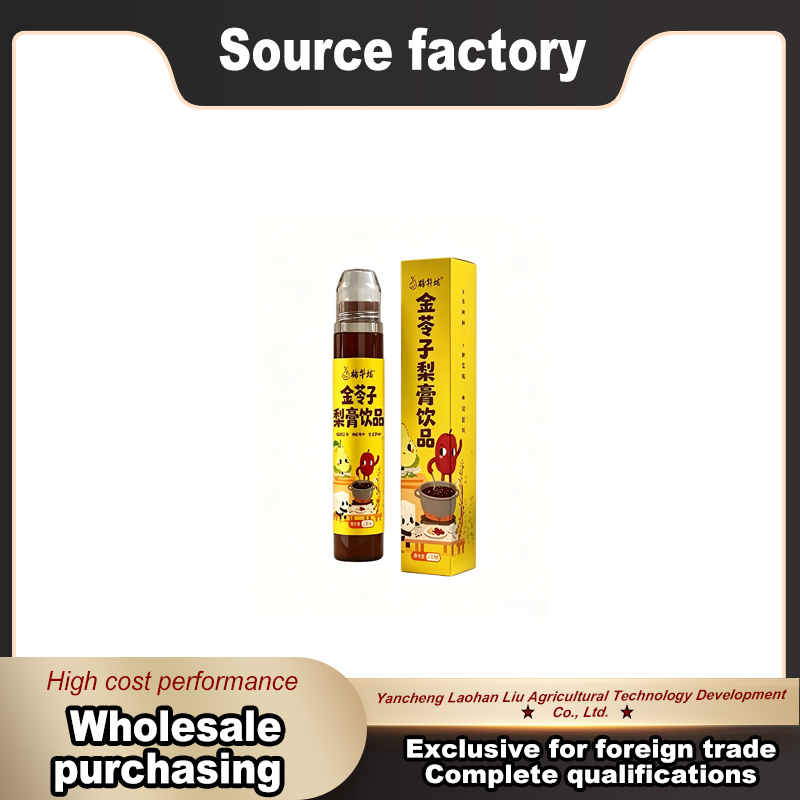
That single constraint is what separates genuine Pure Pear Paste from the pear-flavored syrups that fill most supermarket shelves. It also explains why the category is so easy to fake and so hard to buy well. This guide covers what "pure" should mean in a specification sheet, how Traditional Brewing changes the finished product, and what to verify before you commit to a container.
Yancheng Liu Laohan Agricultural Technology Development Co., Ltd. has been making paste this way from its own orchards in Yancheng, Jiangsu since 2019 — which is why the technical points below are the ones buyers actually argue about.
1. What does "pure" actually mean on a pear paste label?
"Pure" means the ingredient list has one line, and the texture, color and shelf stability are achieved without additives.
Most products sold as "pear paste" or "pear syrup" are pear juice concentrate rebuilt with water, thickened with pectin or modified starch, sweetened with cane sugar or honey, and preserved with potassium sorbate. They are legal, inexpensive, and they taste acceptable. They are a different product.
The yield ratio tells you almost everything
A true reduction paste runs roughly 8–12 kg of fresh pears to 1 kg of finished paste. That is a physical consequence of removing water, not a marketing number. When a quote sits far below the rest of the market, ask for the yield ratio and the Brix reading. One of the two will not survive the question.
- Fresh pear solids enter the kettle at about 12–14 Brix
- Finished paste concentrates to 65–72 Brix
- Water activity typically lands between 0.75 and 0.82
- No sugar is required to reach that concentration — the fruit's own fructose and glucose do the work
- At that water activity, most pure pastes hold 12–18 months unopened without any preservative
That last point matters commercially. Preservatives are usually added to compensate for under-reduction, not because fruit needs them.
The three substitutions to watch for
| What the listing says | What is often inside | How to detect it |
|---|---|---|
| "No sugar added" | Pear juice concentrate or glucose syrup | Request total sugars per 100 g — above ~62 g with a thin, pourable body is a red flag |
| "Honey pear paste" | 20–40% honey, less fruit | Honey is cheaper than reduction; check where honey sits in the ingredient list |
| "Traditional recipe" | Steam-jacketed batch, 90-minute cook | Ask for batch cook-time logs and the kettle type |
The same substitution logic runs through benefit claims. A thin syrup cannot deliver Throat Comfort — it slides off the tissue instead of coating it, so the effect the consumer paid for never happens, and the repeat purchase never follows.
✅ Bottom line: One ingredient on the label and 8–12 kg of fruit per kg of paste — if either is missing, you are looking at a syrup, not a Pure Pear Paste.
2. Does traditional brewing change the product, or is it just marketing?
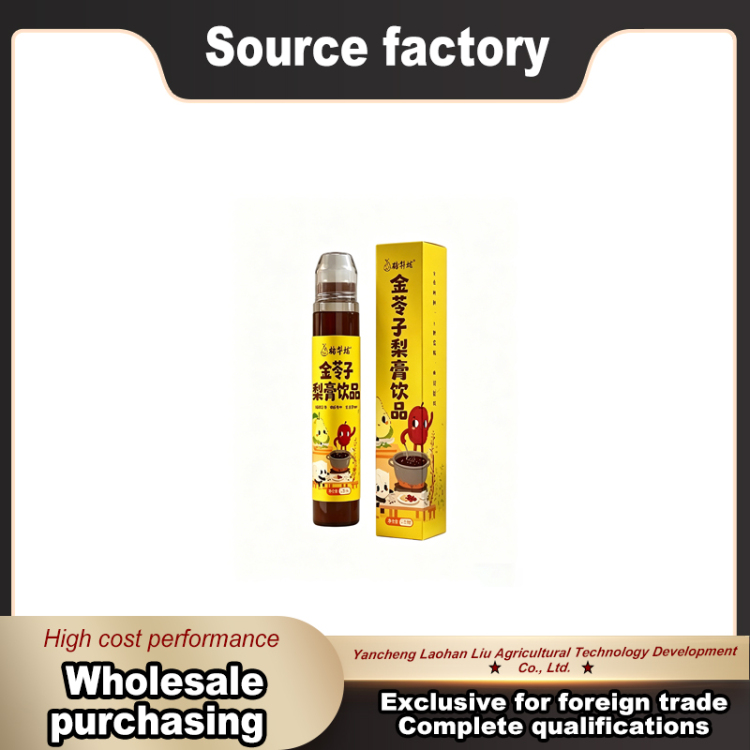
It changes the product measurably — but only when the cook is long, low and slow enough to build body without scorching the sugars.
Traditional Brewing means whole-fruit reduction in an open or semi-open vessel over direct heat, with the cook driven by the batch rather than a fixed timer. Six stages matter:
- Sorting and washing — bruised or over-ripe fruit is pulled out; one fermented pear taints the whole batch
- Crushing and pressing — juice released without enzymatic clarification, so pectin stays in
- Coarse filtration — pulp removed, turbidity kept deliberately
- First reduction — 3–4 hours at a rolling simmer to drive off the bulk of the water
- Slow finishing — 3–6 hours at 85–95 °C, stirred continuously, until the paste sheets off a spoon
- Hot fill and seal — filled above 85 °C into sterilized glass, inverted to sterilize the headspace
Why temperature control matters more than the fuel
Wood fire is the romantic part; the temperature curve is the functional part. Sugars in pear juice begin caramelizing around 110 °C and 5-HMF climbs sharply once the mass sits above 95 °C for hours. Both reactions are irreversible. Overcooked paste turns dark, bitter and slightly medicinal — and no amount of packaging design recovers the sale.
- Hold the finishing stage at 85–95 °C, not higher
- Stir continuously; scorching at the vessel wall is the single most common defect
- Pull the batch at 65–70 Brix, not at maximum thickness, so the paste stays spoonable when cold
- Cool and hold below 30 °C before filling to protect aroma compounds
What to verify before a wholesale order
- Cook-time logs per batch, not a stated range on a spec sheet
- Kettle type — open reduction vessel vs. jacketed tank with vacuum
- Water activity and Brix on the certificate of analysis for the shipment, not the sample
- Orchard control — own base or bought-in fruit, and whether the fruit carries a Green Food or equivalent certification
- OEM and private-label terms — jar sizes, label approval, MOQ per SKU
For reference, LIULAOHAN runs two production lines across a 5,000–10,000 m² facility, with orchard-to-factory raw material supply and Green Food certification on its base fruit. Export terms run FOB, CIF and EXW, with off-season lead times inside 15 working days.
✅ Bottom line: Ask for cook-time logs and a per-shipment water-activity reading; those two documents separate real Traditional Brewing from a relabelled industrial batch.
FAQ
Q: Is Pure Pear Paste the same as qiu li gao or autumn pear syrup? A: Largely, yes. Qiu li gao is the Chinese name for the same reduction product; "autumn pear syrup" and "pear paste" are the common English renderings. The meaningful difference is formulation — classic qiu li gao often includes herbs such as fritillaria or loquat leaf, while a pure version is fruit only. Both are sold as food, and both deliver the same Throat Comfort effect through physical coating rather than pharmacology. Traditional Chinese therapy describes that effect as moistening the lung, which is where the occasional "Lung Moisturizer" label comes from — a phrasing that should not be printed on US or EU retail packs.
Q: How much should a customer take per day, and can children use it? A: A typical serving is 10–15 g, taken directly from a clean spoon or stirred into 100–150 ml of warm — not boiling — water. Because a pure paste has no honey and no added sugar, it is suitable for children over 12 months; honey-based pastes are not. Hot water above 70 °C flattens the aroma, so warm is the better instruction to print on pack.
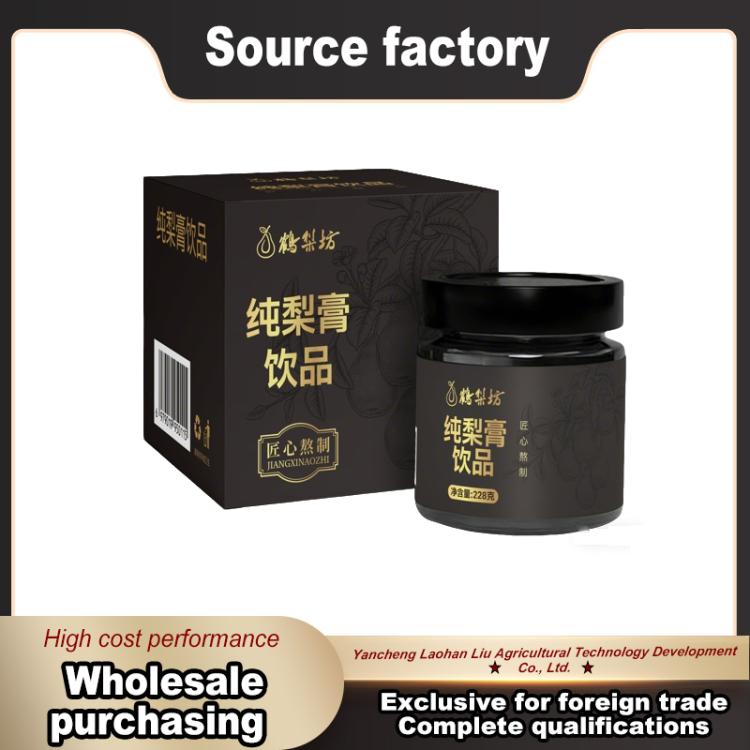
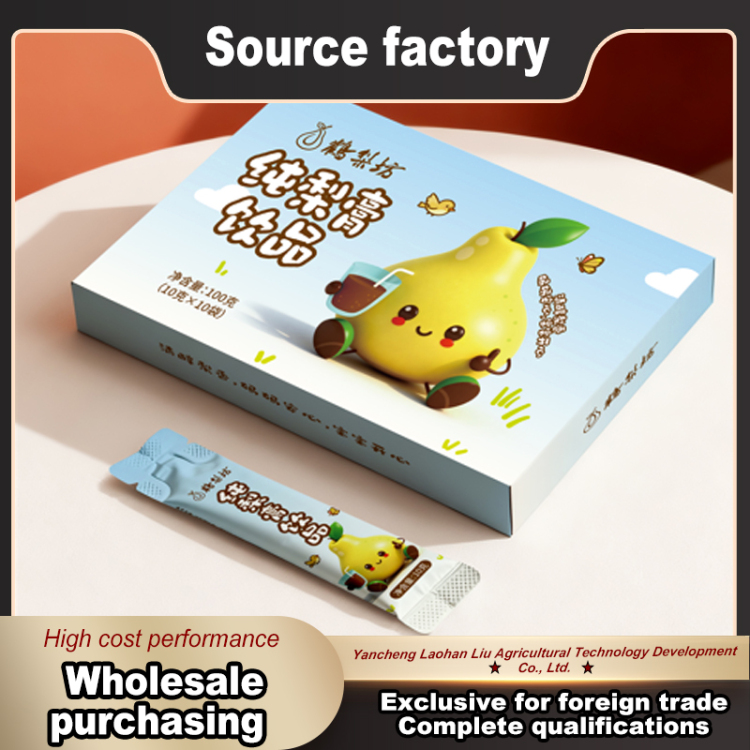
Q: Can a retailer or distributor private-label this product? A: Yes. Yancheng Liu Laohan Agricultural Technology Development Co., Ltd. provides OEM and ODM services with flexible MOQs, from 228 g glass jars to single-serve stick packs and multi-jar gift boxes. Buyers typically supply artwork and receive a pre-production sample before the first production run; label compliance review is handled in-house for the destination market.
CTA: Get a specification sheet and a sample before your next range review
If you are sourcing for a health-food chain, an e-commerce brand or a gifting program, the fastest way to test a supplier is to ask three questions: what is the yield ratio, what is the water activity on the last shipment, and can you cook a batch to my Brix target.
LIULAOHAN answers all three in writing, and ships samples from stock. As a China-based pear paste manufacturer with its own orchard base, the company quotes factory-direct wholesale pricing and supports custom formulations — lower Brix for drink applications, higher Brix for direct-spoon products, herbal variants for regional markets.