

Getting that distinction wrong is the most expensive mistake a new pear paste brand makes: a single non-compliant on-pack claim can trigger a recall, a marketplace delisting, or a customs hold on the whole container. This article separates the two claims by market, then shows which positioning actually sells — and to which buyer.
1. What do "throat comfort" and "lung moisturizer" mean in a food context?
Throat comfort is a permissible structure/function statement; lung moisturizer is a traditional-medicine concept that has to be translated before it can be sold as food.
The confusion comes from the source material. Pear paste originates as qiu li gao, a Qing-dynasty preparation documented in Chinese food therapy, where the governing idea is run fei — moistening the lung. That vocabulary travels badly. In English-language export markets, "moisturizer" is a cosmetic term and "lung" signals a respiratory drug.
Where each claim is defensible
| Claim style | What it asserts | US (FDA) | EU (1924/2006) | Practical verdict |
|---|---|---|---|---|
| "Soothes the throat" / "throat comfort" | Sensory coating effect | Structure/function claim — allowed if truthful and not a disease claim | Borderline; wording must avoid "treats" or "relieves cough" | Usable, keep it sensory |
| "Moistens the lungs" / "lung moisturizer" | Effect on respiratory tissue | Reads as a drug claim | Not on the authorised claims list | Do not print on US/EU retail packs |
| "Supports respiratory health" | Implied disease-area benefit | High enforcement risk | Not authorised | Avoid |
| "Traditional pear paste, prepared the Qing-dynasty way" | Heritage and process | Allowed — it is a process claim, not a health claim | Allowed | Best export framing |
Where the traditional language still works
"Lung moisturizer" is not banned content; it is mis-placed content. Three legitimate homes for it:
- Educational and editorial pages — explain run fei as cultural context, clearly labelled as traditional use rather than established effect
- Markets with TCM regulatory pathways — China, Hong Kong, China, Singapore and Malaysia, where 润肺 (moisten the lung) is a recognised food-therapy descriptor
- Practitioner and specialist channels — TCM clinics, acupuncture suppliers, Asian grocery wholesalers, where the buyer already owns the vocabulary
Every version of the claim needs a companion line: this is a food, not a medicine, and it is not intended to diagnose, treat, cure or prevent any disease. That sentence costs nothing and removes most of the enforcement risk.
✅ Bottom line: Sell the sensation, not the organ — "throat comfort" is compliant in most markets, "lung moisturizer" belongs in education and TCM-native channels.
2. Which positioning sells better, and to whom?
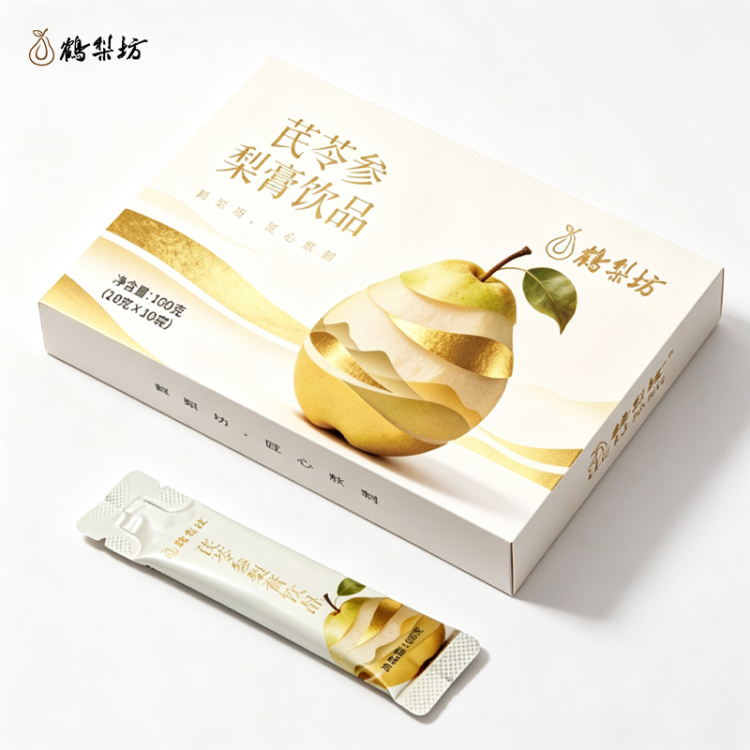
Throat comfort wins volume in mainstream retail; lung moisturizer wins margin in specialist channels — and the strongest brands run both with different labels.
For a distributor building a range, the two claims map onto two different shelf sets and two different price ceilings.
The four buyers who actually repeat-purchase
- Voice professionals — teachers, call-centre staff, singers, auctioneers. They buy on repeat, care about sugar content and stick-pack portability, and respond to "no sugar, no honey, no dilution" far more than to heritage stories.
- Dry-season households — northern China, Korea, Japan and northern Europe from September to February. They buy jars, not sticks, and they buy two at a time.
- Parents — the decisive filter is honey. A Pure Pear Paste with no honey and no added sugar can be given to children over 12 months; a honey-based paste cannot. Say this on the front of pack.
- Gifting and corporate buyers — Q4 and Lunar New Year. Multi-jar boxes and 228 g glass jars outsell everything else per unit of shelf space.
The demand calendar is not flat
- August–September — back-to-school voice strain; stock stick packs
- October–December — dry-season peak and gifting; stock jars and boxes
- January–February — Lunar New Year gifting, plus post-holiday recovery demand
- March–July — the trough; use it for private-label production runs and reformulation
Buyers who order only in the peak pay peak lead times. LIULAOHAN quotes off-season lead times inside 15 working days against a 1–3 month peak-season window, so a March purchase order lands at better cost and better terms than a November one.
Matching format to claim
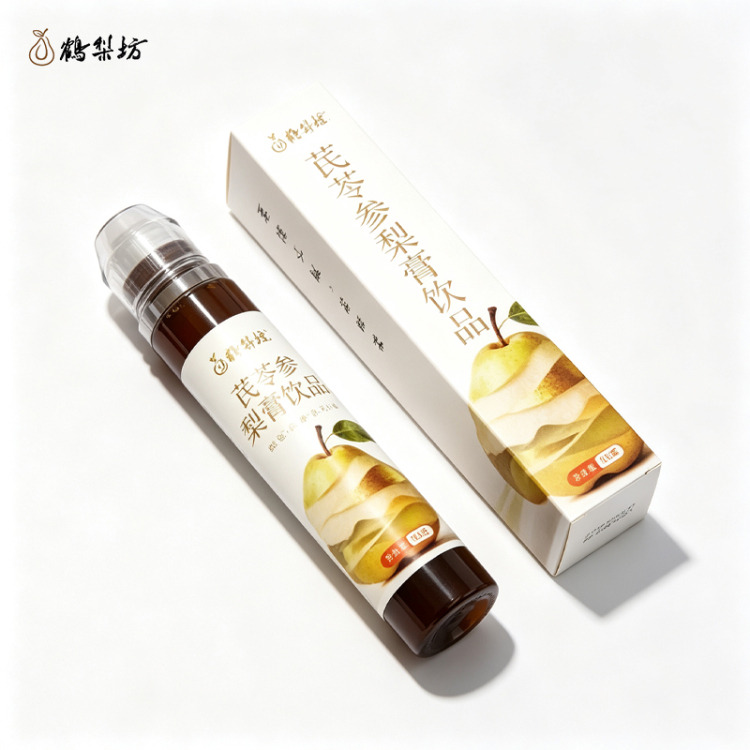
- Stick packs (10–15 g) — throat comfort, on-the-go, voice professionals, exam-season students
- 228 g glass jars — household dry-season use, gifting, best spoonable price per gram
- Two-jar and family boxes — Q4 gifting, corporate orders
- Herbal variants — specialist and TCM channels, where the lung-moisturizer language is understood
Whichever format you choose, the specification does not change: one ingredient, 8–12 kg of pears per kg of paste, 65–72 Brix, water activity under 0.82. That spec is what makes a Pure Pear Paste credible as throat care in the first place — a thin, pourable syrup coats nothing.
✅ Bottom line: Run throat comfort as the volume SKU and lung moisturizer as the specialist SKU; same paste, two labels, two price points.
FAQ
Q: Can I print "lung moisturizer" on packaging sold in the United States? A: No. US rules treat an effect on lung function as a drug claim, and a conventional food carrying it is misbranded regardless of how the claim is phrased. Describe the product as a traditional pear paste, keep benefit language sensory — soothing, coating, comforting — and move the run fei explanation to your website, clearly framed as traditional use.
Q: Is pear paste a substitute for cough syrup? A: No, and it should not be marketed as one. A cough syrup contains an active pharmaceutical ingredient; a Pure Pear Paste is a food whose benefit is a demulcent coating effect on the throat — no glycerin, no menthol, no active ingredient. That coating is genuinely useful for dryness, hoarseness and voice strain, and useless against a bacterial infection. Position it as daily throat care, not acute medicine — the customer who understands the difference is the customer who reorders.
Q: What should a first order look like for a new brand? A: Start with two SKUs, not six: a 228 g jar for household use and a 10-stick pack for trial and travel. Private label is available with flexible MOQs, and Yancheng Liu Laohan Agricultural Technology Development Co., Ltd. supplies artwork templates and pre-production samples so label compliance can be checked before the run. First orders from new distributors typically ship within 15 working days outside peak season, FOB, CIF or EXW.
CTA: Get both label versions tested before you commit
The cheapest way to de-risk a pear paste launch is to have a supplier review your copy against the destination market's claims rules before you print. LIULAOHAN does this in-house for buyers across Japan, Korea, Southeast Asia and Europe, and ships samples with the matching certificate of analysis so your regulatory consultant can check the numbers, not just the taste.
As a pear paste manufacturer working from its own orchard base in Yancheng, Jiangsu, the company offers factory-direct wholesale pricing, OEM and ODM service, and custom Brix targets for drink, spoonable and gifting formats.