
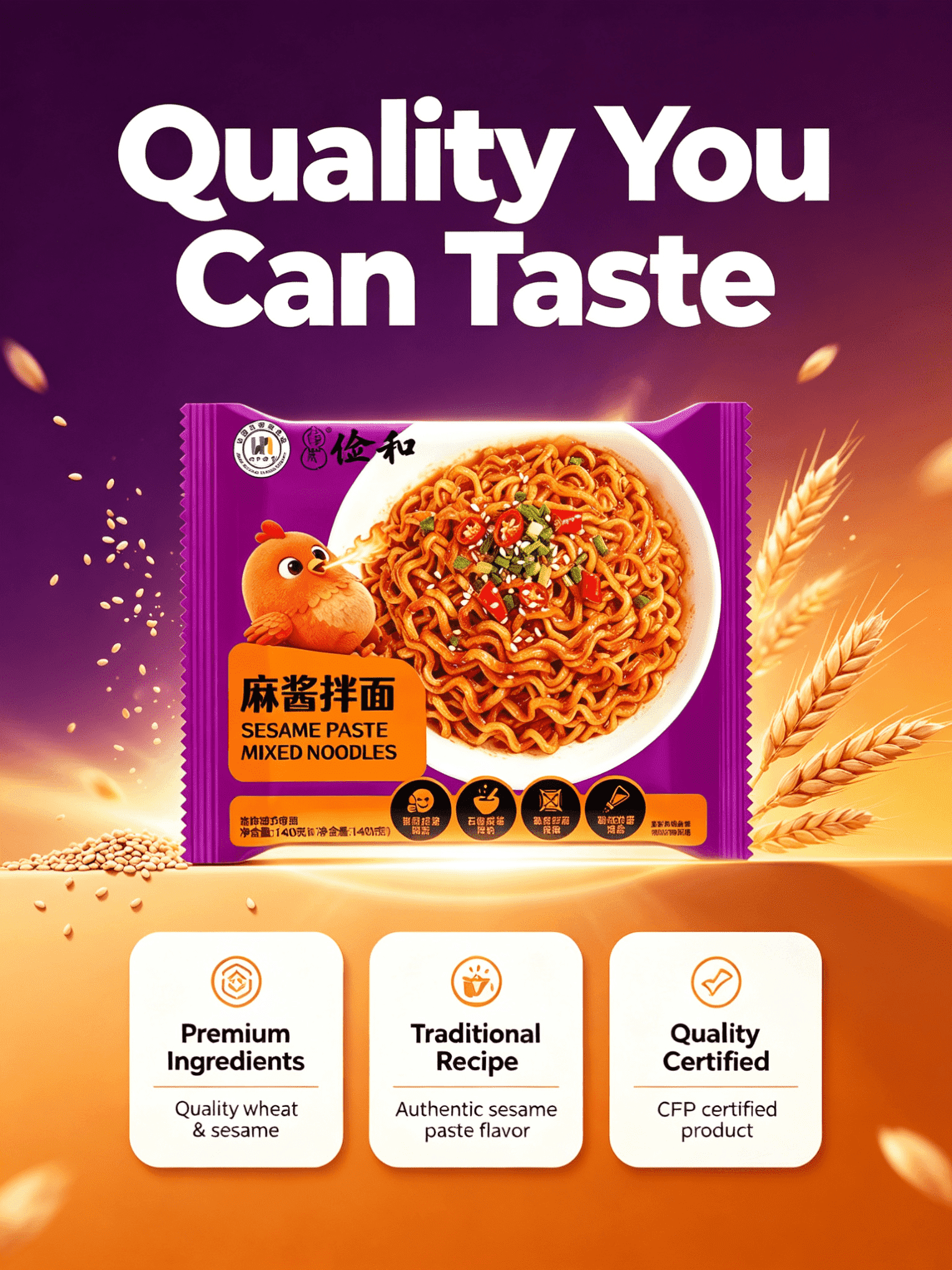
"Firm bite" is not a specification — it is two separate measurements that buyers routinely collapse into one: how much broth the cake absorbs, and how long it keeps its structure while absorbing it. A cake can drink well and fall apart, or hold shape and taste bland. What you need is high broth absorption noodle cake for hot pot service that scores well on both, and the way to get it is to stop using adjectives in your RFQ.
Henan Liangtai Food Co., Ltd. runs two fried instant noodle lines in Mengzhou, Henan, and quotes absorption and holding performance as separate line items. This is the specification sheet most wholesale buyers never ask for, and it is the one that ends arguments with the kitchen.
1. What does "firm bite" actually mean in a specification?
It means an absorption ratio and a structural holding window, measured separately at your service temperature. Absorption ratio is cooked weight divided by dry weight. Holding window is how many minutes the cake survives in a rolling 95-100°C broth before it breaks up or clouds the soup.
Those two numbers move independently. A fried cake is porous, so it drinks fast — typically 2.0 to 2.5 times its dry weight — but the same porosity is what makes it soften after 8-12 minutes. An air-dried cake is denser, absorbs slightly less at 1.8 to 2.2 times, and holds 15-20 minutes. Starch vermicelli absorbs the most at 3.0 to 4.0 times and holds longest, but contributes almost no protein.
| Product | Absorption ratio (cooked / dry) | Structural hold at 95-100℃ | Protein per 100g | Best service format |
| Fried wheat noodle cake | 2.0-2.5x | 8-12 minutes | 8-10 g | Three-minute service, noodle soup chains |
| Air-dried wheat cake | 1.8-2.2x | 15-20 minutes | 8-10 g | Shared pots, clear broths |
| Starch vermicelli | 3.0-4.0x | 25-40 minutes | Under 1 g | Red oil bases, buffet hot holding |
Three variables drive both numbers, and they are the ones worth specifying:
- Corrugation depth. Deeper waves carry more sauce per gram, which raises perceived flavour without raising weight.
- Cake density. Denser cakes hold longer but absorb slower. This is the direct trade-off.
- Water-to-cake ratio in the pot. A crowded basket drops the broth temperature and changes the result, so test at your real batch size.
✅ Bottom line: Replace "firm bite" with two numbers — absorption ratio and holding window — or you will get whichever cake is cheapest to make.
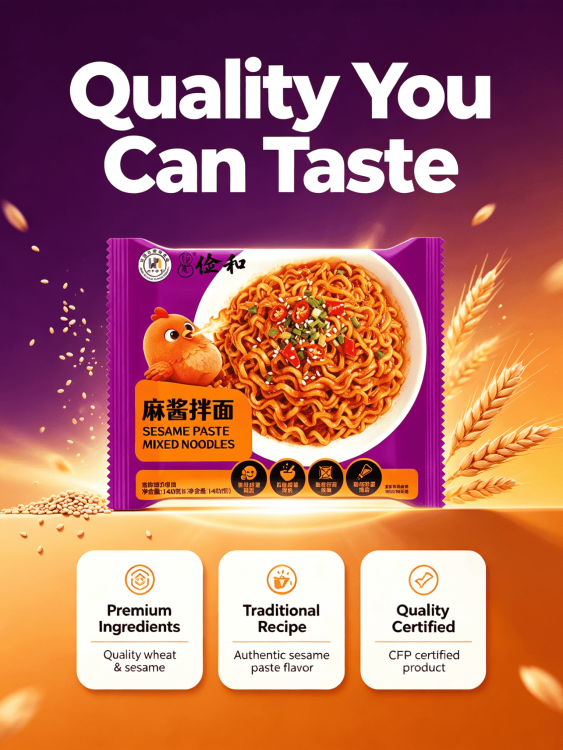
2. How to test broth absorption of instant noodle cakes?
Weigh the dry cake, cook it in your own broth at your real batch size, drain for 30 seconds, weigh again — and then keep it in the pot and watch when it breaks. The whole test takes 25 minutes and needs only a scale, a timer and a ladle.
Here is how to test broth absorption of instant noodle cakes, in four steps:
- Weigh dry. Record the dry weight of one cake to one decimal place.
- Cook to your standard. Use your own broth at 95-100°C, at the batch size you actually serve, for the time on your current spec sheet.
- Drain and weigh. Lift, drain 30 seconds, weigh. Divide cooked weight by dry weight to get the absorption ratio.
- Hold and observe. Return the cake to the rolling broth and check at 5-minute intervals. Record the minute it first breaks, sheds fragments, or visibly clouds the broth.
Run the test on two or three candidate cakes the same afternoon, in the same broth. The difference between a 2.1x and a 2.4x cake is obvious on the plate and invisible on a spec sheet.
Then write the result into your RFQ as a measurable line:
| Vague request | Measurable specification |
| "Good broth absorption" | Absorption ratio of at least 2.2x at 4 minutes at 95-100℃ |
| "Firm bite" | No structural break at 12 minutes in a rolling broth |
| "Does not go mushy" | Under 10% weight loss as fragments after 15 minutes |
| "Does not cloud the broth" | Passes a side-by-side jar test against your current product |
That table is also the fastest way to compare two quotes. If one supplier cannot fill in the right-hand column, you are buying a commodity cake and hoping, not buying high broth absorption noodle cake for hot pot service.
Jianhe will run that test with you on a noodle cake that absorbs hot pot broth without breaking and report both numbers before you commit to a specification. Henan Liangtai Food adjusts corrugation depth and cake density on OEM/ODM orders, which is how you move one number without losing the other.
✅ Bottom line: A 25-minute kitchen test with a scale replaces every adjective in your specification and settles the argument with evidence.
FAQ
Q: Can a cake absorb well and still hold its structure?
A: Yes, but it costs more to make. High absorption with a long holding window needs controlled density rather than simple porosity, which is why high broth absorption noodle cake for hot pot service usually sits at a higher unit price than a standard fried block.
Q: What absorption ratio should I target for hot pot?
A: Around 2.2x to 2.5x for red oil bases, where the cake is carrying fat as well as broth. For clear broths, 1.8x to 2.2x with a longer holding window tastes cleaner.
Q: Do I need lab equipment to run this test?
A: No. A 0.1g scale and a timer are enough for the absorption ratio, and the holding window is judged by eye at 5-minute intervals. Jianhe provides a test sheet with samples, and will quote a noodle cake that absorbs hot pot broth without breaking against your measured numbers rather than a generic grade.
Send us your broth type, service temperature and target holding window, and Jianhe will send sample cakes with a one-page test sheet so your kitchen can measure absorption ratio and structural hold in a single afternoon. Henan Liangtai Food Co., Ltd. supplies a noodle cake that absorbs hot pot broth without breaking, with custom corrugation and density on OEM/ODM orders and mixed-container wholesale shipments from 500 cartons. If you need help running how to test broth absorption of instant noodle cakes in your own kitchen, our product team will walk your chefs through it.
Published: September 2026 | By Jianhe Product Team, Henan Liangtai Food