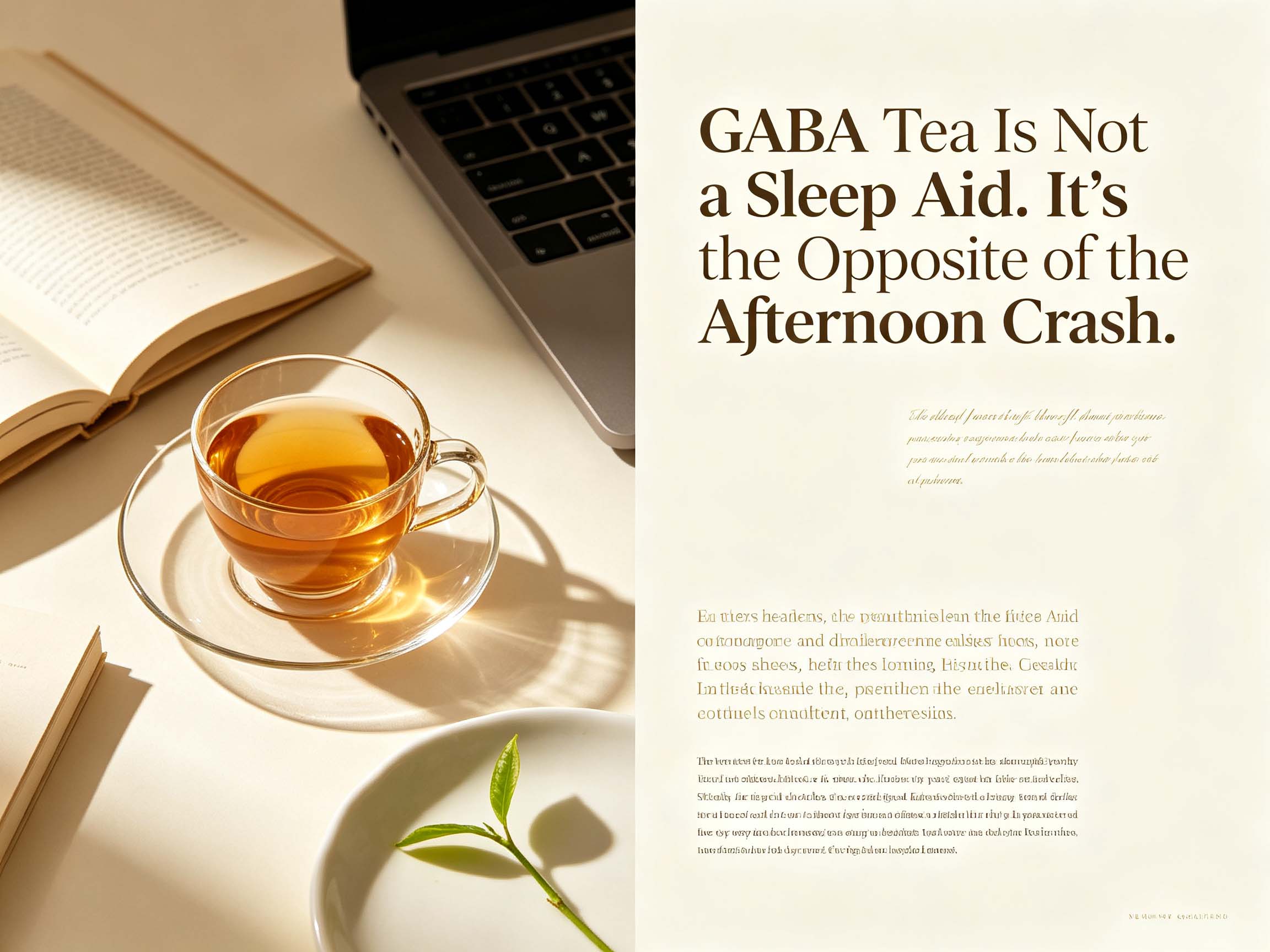
The GABA category has been built around bedtime. PINXIAOMAN is making the case that its real job starts at 3 p.m., when focus frays and the second coffee stops working.
GUANGDONG, China — November 12, 2026 — Search for “GABA tea” and the results tell a consistent story: sleep, relaxation, stress relief. But the fastest-growing query pattern in functional tea is not about bedtime. It is about the hours before it — the afternoon slump, the 3 p.m. crash, the point where another coffee creates more problems than it solves.
PINXIAOMAN, the Guangdong-based GABA oolong supplier, is building its overseas positioning around that gap. The company's argument is straightforward: GABA tea is not a sedative. It is an afternoon tea for calm focus — and the difference matters for B2B buyers trying to build a functional beverage line that does not compete in the already-crowded sleep aisle.

Why “GABA tea for sleep” is the wrong search frame
The sleep framing is not baseless. GABA is the central nervous system's primary inhibitory neurotransmitter, and it does calm neural excitation. But calming excitation is not the same as inducing drowsiness — and the human data on GABA-enriched tea points somewhere more specific. A 2023 study in Foods found that 28 days of GABA oolong consumption increased alpha brain waves, the EEG pattern associated with relaxed focus rather than sedation. L-theanine, which co-occurs naturally in tea, shifts activity away from stress-linked beta waves while preserving cognitive sharpness — a state researchers describe as “mental clarity without sedation.”
In search terms, this is a category that has been mis-indexed. Consumers looking for focus tea, calm energy without jitters, or what to drink instead of a second coffee are not well served by pages optimized for “GABA tea for sleep”. For overseas brands building functional tea SKUs, that misalignment is an opportunity: own the afternoon occasion, and the category stops looking like a melatonin competitor.
The afternoon crash is a different problem from insomnia
The 3 p.m. dip is not a sleep deficit. It is a convergence of circadian rhythm, post-lunch blood sugar movement, and a cortisol curve already on the downslope. Caffeine borrowed at that hour creates a second spike-and-crash and leaves residual stimulant in the system when the brain needs to wind down at night. The search behavior around afternoon slump tea and tea instead of coffee at 3pm reflects a consumer need that sleep-positioned GABA products do not address.
PINXIAOMAN's GABA oolong is positioned against that need, not against sleep aids. The company uses a nitrogen-based anaerobic enrichment process adapted from Japanese Gabaron technology, stabilizing GABA content above 150 mg per 100 g — the Japanese commercial threshold. The oolong base is finished to remove the pickled, sour notes that have historically limited GABA tea's appeal beyond health-focused buyers, leaving floral and fruity aromas. The result is a tea that can be marketed on taste and occasion, not only on a health claim.
What this means for B2B buyers building a functional tea line
The commercial case is not that GABA tea replaces melatonin. It is that the afternoon functional occasion is under-served relative to sleep, and GABA oolong has the process story, the sensory profile, and the regulatory positioning to occupy it. For distributors, private-label wellness brands, and foodservice buyers, that translates into a product that can sit in the “calm focus” or “smart energy” set rather than fighting for shelf space in the sleep set.
One search-side risk needs to be managed deliberately: GABA the food component is frequently confused with gabapentin, a prescription medication. Consumers actively mix the two in search and community discussion, and the confusion is common enough that it appears in clinical and forum contexts. Any brand building GABA tea content should include a plain-language clarification — GABA tea is a beverage made from Camellia sinensis, not a drug — because that clarification also builds trust with the more cautious buyer segment.
Supply-side first, consumer launch later
PINXIAOMAN has not yet launched a consumer-ready GABA finished product and is not currently selling GABA finished goods directly to consumers. Its overseas standalone site, www.pxmpinxiaoman.com, is structured as a B2B supply and OEM channel for distributors, wellness beverage brands, and private-label retailers. The company offers formulation adjustment, flavor customization, packaging support, and bulk orders. Its current SEO posture — including existing newsroom content on GABA oolong supply and search trends — is consistent with that supply-side positioning: build topical authority around “GABA oolong tea” and “GABA tea supplier,” then convert that visibility into OEM inquiries rather than DTC sales.
For overseas partners, the proposition is narrower than the sleep aisle and more defensible: the afternoon is where the habit lives, and GABA oolong is a supply-ready ingredient for brands that want to own it.
About PINXIAOMAN
Founded in 2019 and headquartered in Guangdong, China, PINXIAOMAN is a tea-industry company integrating brand operations, product development, and global trade. Its GABA oolong line uses anaerobic enrichment technology with stable GABA content above 150 mg per 100 g, with certifications aligned to China, U.S., EU, and Japanese market requirements. For overseas OEM and bulk inquiries, visit www.pxmpinxiaoman.com.
Media Contact
Email: [email protected]
Website: www.pxmpinxiaoman.com