
1. Does Frying or Air-Drying Change How Your Noodle Bowl Is Classified?
No — at the six-digit level, the drying method is invisible to customs. An instant noodle cake is cooked twice before it is ever dried: steamed to gelatinise the starch, then either flash-fried at roughly 15–22% oil or hot-air dried down to roughly 10–12% moisture. HS 1902.30 is written for pasta "whether or not cooked … or otherwise prepared", so both routes land in the same subheading, and every WTO member applies that six-digit text identically.
What does push a bowl out of 1902.30 is a change in the product, not in the process:
- ❌ Never pre-cooked. Raw dried noodles — the dried wheat noodle or rice stick sold to be boiled at home — sit in 1902.11 or 1902.19. Vietnam publishes the gap openly: dried transparent vermicelli at 20% MFN (1902.19.30) against 30% for an instant bowl (1902.30.40).
- ❌ Rice instead of wheat. Pre-cooked rice is not pasta. It falls to 1904.90 — 14% in the US against 6.4%, and 8.3% plus €46 per 100 kg in the EU. The HS code for instant rice noodle bowl classification only changes at the moment pre-cooked rice enters the bowl — and then it leaves Chapter 19 entirely.
- ❌ Meat past 20% of net weight. That threshold moves a beef-pouch bowl into Chapter 16 in the EU and China, and drags veterinary inspection behind it.
- ✅ Sauce, oil and garnish sachets do not move the code. General Rule 3(b) gives the noodle essential character, which is why a bowl with three sachets is still "pasta".
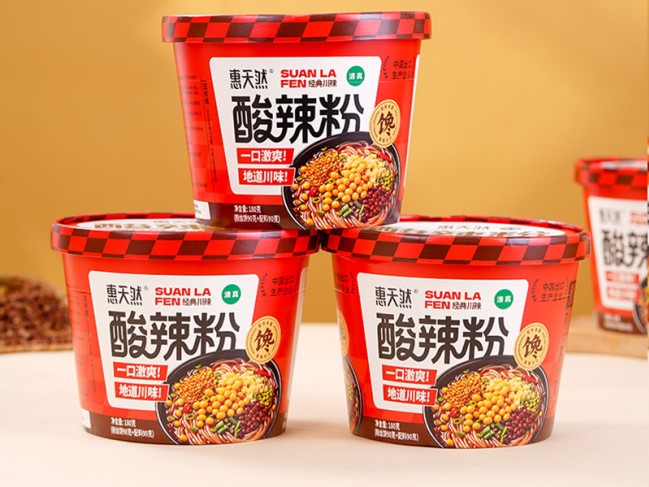
This is why Huitianran runs frying and hot-air drying on the same site yet issues a separate tariff sheet for every SKU: a fried bowl from our Instant Noodles range and a hot-air-dried bowl can leave on one pallet under two different national lines.
✅ Bottom line: Fried and air-dried bowls share HS 1902.30, so the drying method never saves duty — only pre-cooking, grain or meat content changes the code.
2. What Instant Noodle Import Duty Rate Applies Where You Sell?
Fix the national line first, read the tariff column second, read the weight third — in that order. Any instant noodle import duty rate by country comparison collapses into noise if you line up headline percentages, because the same 6.4% produces a 12% bill in one port and a 27% bill in another.
|
Market |
National line (2026) |
MFN duty |
Best route from China |
Duty on a US$10,000 CIF shipment |
|
United States |
1902.30.00 |
6.4% |
none — no FTA for China-origin |
US640 + Section 301 25% = **US3,140** |
|
European Union |
1902 30 |
6.4% |
none |
US$640 |
|
United Kingdom |
1902 30 00 |
6% + £20 per 100 kg |
none |
≈US$2,630 on 8,000 kg |
|
Japan |
1902.30-210 |
3.8% (WTO) |
RCEP, staged |
US$380 |
|
Vietnam |
1902.30.40 |
30% |
0% with Form E |
US0 instead of US3,000 |
|
Malaysia |
1902.30.4000 |
8% |
0% under ACFTA |
US0 instead of US800 |
The US rate is a stack, not a number. 6.4% is only the MFN layer; Section 301 adds 25% at the eight-digit line, and any IEEPA or reciprocal measure in force on the day of entry lands on top. Cost the order at 31.4% minimum and confirm the live stack with your broker before you quote a shelf price.
The UK rate is where air-dried quietly loses. The £20 per 100 kg is a specific duty — £0.20/kg charged before the 6% ad valorem. On bulk air-dried noodles at US1.20/kg that is 21% of value, so the effective rate is 27%. On a US4.00/kg bowl it is 5%, for 11% total. You are paying duty on water: a 200 g air-dried "fresh" bowl carries 30–40 g of moisture that a 110 g fried bowl does not. That is the only sense in which fried versus air-dried ever changes your landed cost.
Form E is the biggest single lever in ASEAN. So can I import instant noodles duty free with a form E certificate? In Vietnam and most of ASEAN, yes — Form E takes 1902.30.40 from 30% to zero. But the certificate must match the entry: six-digit code in box 4, direct consignment, third-party invoicing declared in box 13, and a back-to-back Form E if the container transships through Singapore or Port Klang. The most common refusal at post-clearance audit is a factory code that does not match the importer's declaration.
Rice bowls are a different tariff family. This is where Instant Rice costs more than noodles: 14% against 6.4% in the US, 8.3% plus €46 per 100 kg in the EU, 8% plus £38 per 100 kg in the UK. Confirming the HS code for instant rice noodle bowl classification as 1904.90 before you cost a mixed container is worth more than any freight negotiation, because a noodle-only duty estimate understates a rice SKU by more than half.
Malaysia splits the line by product type, which almost no supplier flags: rice vermicelli at 5%, transparent vermicelli at 6%, other instant noodles at 8%. Vietnam splits it too, inside 1902.30 itself — rice vermicelli at 1902.30.20, other instant noodles at 1902.30.40. Two to three points of duty are decided by the description on the invoice, so Instant Vermicelli SKUs need a local description that matches the national line rather than a generic "noodle bowl".
✅ Bottom line: Your duty is set by the tariff column you can legally claim and the weight you declare, not by how the noodle was dried.
FAQ
Q: Is instant vermicelli classified differently from instant noodles? A: At six digits, no — a pre-cooked vermicelli bowl is also 1902.30. At national level, sometimes yes: Malaysia separates rice vermicelli at 5% from other instant noodles at 8%. Huitianran writes the local description into the commercial invoice for each Instant Vermicelli SKU, which is what the broker actually reads at the counter.
Q: Can I import instant noodles duty free with a form E certificate for a mixed-flavour container? A: Yes, provided every line is declared under the same six-digit code and the quantities reconcile. Flavours are invoice lines, not separate codes, so a 60/40 split of two flavours inside one carton does not affect preference — but keep flavour-level quantities traceable, because a post-clearance audit will reconcile box 4 against the entry line by line.
Q: Does a rice bowl really cost more to import than a noodle bowl? A: In most markets it does. The HS code for instant rice noodle bowl classification is 1904.90, taxed at 14% in the US against 6.4%, and 8.3% plus €46 per 100 kg in the EU. Run the instant noodle import duty rate by country comparison on your own carton weight before you commit to a shelf price, or an Instant Rice line can look profitable at FOB and lose money at the border.
Get a Tariff Sheet for Every SKU Before You Book the Container
Send Huitianran your SKU list, pack size and destination port. We return a one-page tariff sheet per SKU: the six-digit code, the national line, the applicable preference route, and the duty figure on your actual carton weight — the same sheet we attach to Instant Noodles OEM orders before production starts. As a China manufacturer running both fried and air-dried formats, we can quote wholesale and bulk prices against either process, so you see the landed cost of both before you choose.
Contact our export team at Henan Huitianran Food Co., Ltd. for a classification and landed-cost review. Custom and private-label orders ship in 15 working days off-season.
Email: [email protected] Mobile: +86 18238035888
Website:www.huitianranfood.com