Protein amino acids, which are mostly of the L configuration, can be converted to the D type under natural conditions. This process reduces the spin of amino acids, so it is also called racemisation. The process is usually slow, so the ratio of D- to L-amino acids can be used to determine the age of fossils, changes in coastlines, and so on.
Are the chiral amino acids in tea also racemic? Can it also be used to observe the storage period, storage conditions and processing degree of tea or tea products? To answer this question, we must first know whether there are D-type amino acids in tea or not? Can the production, processing and storage of tea cause the spinning of amino acids?
Identification of D-type amino acids in tea
Recently, a team of researchers from the State Key Laboratory of Tea Tree Biology and Resource Utilisation of Anhui Agricultural University, Xiaochun Wan and Xiaogan Yang, published a paper entitled `Identification of D-amino acids in tea leaves` (Identification of D-amino acids in tea leaves) in the journal Food Chemistry. amino acids in tea leaves). The preliminary study showed that 11 isomers of D-amino acids could be detected in tea leaves, and that the cycling of amino acids in tea leaves was related to the processing method and storage time. The following briefly describes the content and outlook of this thesis.
Research Objective:
To establish a method for the enrichment, non-derivative splitting, and simultaneous identification and detection of 19 protein amino acids as well as the enantiomers of theanine in tea broth; to validate the hypothesis of the presence of D-type amino acids in tea and to explore the relationship between the processing and storage process of tea and the enantiomerisation of amino acids.
Main analytical instruments:
Agilent high-performance liquid chromatography with 6545 high-resolution quadrupole time-of-flight liquid-mass spectrometry (LC/Q-TOF) system (Figure 1).
Study Pathway:
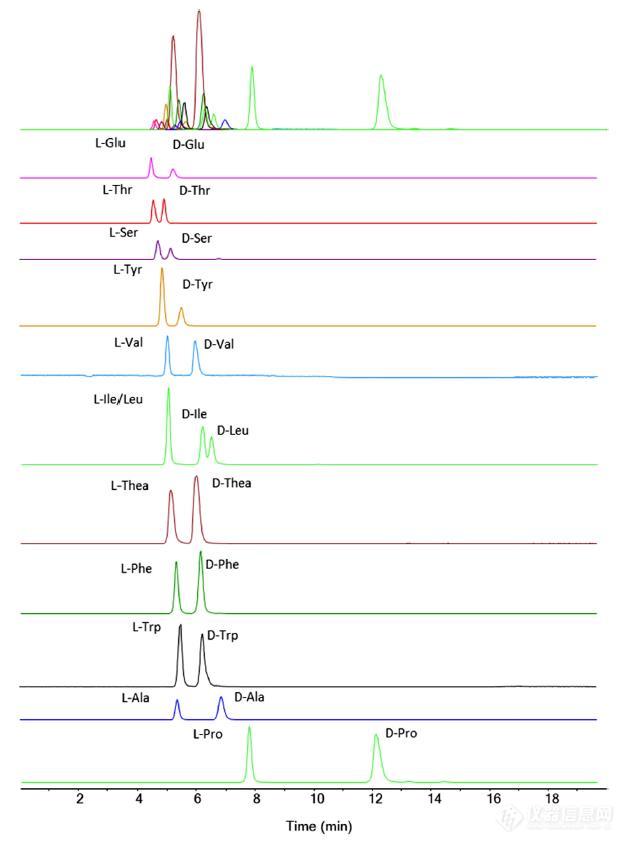
The free amino acids in tea broth were extracted by ion-exchange solid-phase extraction, and the enriched amino acids were split into 20 pairs of amino acid enantiomers by chiral liquid chromatography, followed by mass spectrometry detection by 6545 LC/Q-TOF, which performed both full and daughter ion scans for the compounds under test in order to achieve qualitative identification and quantitative determination in the same analysis. The amino acid isomers of 19 tea samples were analysed to study the relationship between different processing techniques, different storage times and D- and L-amino acid concentrations.
Research results:
1) An analytical method for D-type amino acids was established. It is characterised by the purification of amino acids in tea broth by ion exchange enrichment, and the simultaneous separation and identification of amino acid enantiomers using chiral chromatography for the splitting of non-derivatised amino acid enantiomers and mass spectrometry for the discriminatory ability of different amino acids (Fig. 2).
2) Verification of the hypothesis that tea contains D-type amino acids. The detection of amino acid enantiomers in 19 tea samples showed that only L-type amino acids were found in tea fresh leaves, and no D-type amino acids were found. In contrast, 11 D-type amino acids were detected in the processed tea samples, spanning a wide range of levels from traces to 43 µg/g. The results of the study proved the validity of the hypothesis that D-type amino acids are present in tea.
3) Relationship between tea processing conditions as well as storage time and amino acid isomerisation. Studies on different years of White Peony, Dahongpao and Keemun black teas showed that the processing and storage conditions of tea leaves had a direct relationship with the degree of amino acid racemisation and degradation. the concentration of D-amino acids and the D/L ratio usually increased with the ageing time (Fig. 3); the degree of amino acid racemisation varied among different types of amino acids under the same conditions; and the processing of black teas had a greater impact on the racemisation reaction of amino acids, which was probably related to the fact that the black teas were fermented during the curing and fermentation of black teas. microbial action during black tea curing and fermentation.